Goldsmiths Autumn Term 2023.
Updated: Jun 9, 2025
Here are some of my favourite features, reviews and musings produced in my second-year journalism module at Goldsmiths, University of London.
ORIGINAL NEWS STORY
Fresh from the studio, Fluidity in Materials takes over local Peckham arts venue.
An art exhibition with works from emerging Goldsmiths artists will open this week in Southeast London.
Fluidity in Materials is an exhibition curated by Goldsmiths Fine Art and History of Art students. The works, produced by artists studying at Goldsmiths, will be exhibited in Safehouse 2, a gallery space in Peckham. Members of the public can visit the exposition from 1st to 3rd of November, with the private view taking place from 6 to 9 pm on the 1st of November.
This event is about “empowerment and equality,” explains Alice Ray, the second-year art student directing Materials in Fluidity.
She elaborates on the theme and title of the exhibition: “The theme of fluidity in materials was born through open discussion and a sense of wanting to exhibit art without all of the usual fussy rules that might apply in larger galleries.”
At the heart of the show’s meaning, Alice says, is, “openness, expansion and experimentation with materials.” The organisers have used the term “materials” in its broadest sense, covering all disciplines of fine arts, from sculpture to performance and fashion.
Ari Song, an exhibiting artist and member of the organising committee, elaborates on the relationship between materials and fluidity: “Many participating artists often focus on the characteristics of the materials, and often, this fluidity naturally comes from the materials.”
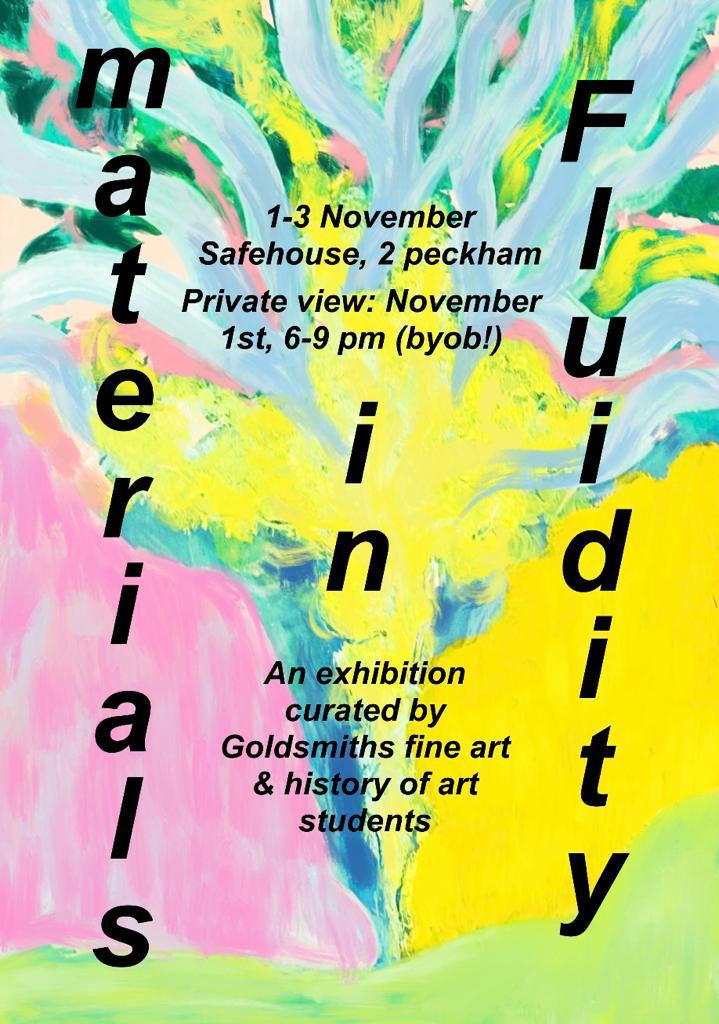
Alice Ray says she let her feelings and intuition guide her to Safehouse 2, the chosen gallery space. An abandoned Victorian home in Peckham, the venue is let by Maverick Projects for exhibitions, photoshoots and filming.
Alice concludes, “I hope that the refined and powerful artwork on display really contrasts and shines against the beauty of the old building and the unfinished quality possessed by a lot of the work on display is given a space to breathe and be accepted in its unfinished beauty.”
Fluidity in Materials will take place from the 1st to 3rd of November. The address of Safehouse 2 is 137 Copeland Rd, London SE15 3SN. The private view will open the show on Wednesday evening.
VOX POP
Londoners, how do you like your pasta?
World Pasta Day falls on Wednesday the 25th of October. The annual celebration of this versatile carb was launched back in 1995 by members of the Union of the Organizations of Manufacturers of Pasta Products in the E.U. (yes, that’s a real thing). While our headlines are swamped by divisive debate and political polarisation, there is surely no better occasion to unite us than a light-hearted vox pop featuring fettucine and fusilli. Most people will agree that a good pasta dish is hard to beat. In fact, we Brits consume around £272 million worth of the stuff annually. We hit the streets to find out what Londoners’ preferred pasta dishes are.

Mac and cheese emerged as a clear favourite, as both Joshua, a student at Goldsmiths University, and Patrick, a pizza chef from Hackney, chose this cheesy, creamy comfort dish. Abdullah, 18, also a student, didn’t hesitate to declare lasagne. Patrick had swung this way first, but decided on mac and cheese following some profound internal reflection. Their friend Jacob was confident with his ballot for spaghetti meatballs.
Yolanda, 41, an artist visiting from Poland, was the only participant who had prior knowledge that such an occasion as World Pasta Day existed, and described herself as a lover of pasta:
“Any pasta is good, but I guess my favourite is the simplest, cacio e pepe, with parmesan, black pepper and butter, rather than olive oil.”
Another artist, Ari, who lives in Greenwich, explained her current favourite was her “Mediterranean pasta dish” filled with artichokes, red peppers, lots of olives and olive oil. She had recently discovered this dish from a new recipe book purchased in central London.
Connie, a bartender living in New Cross, was more hesitant to commit:
“Okay, it’s a really tough one…sometimes you can’t beat a simple pasta like cacio e pepe…But I like spice, what’s that spicy pasta dish? It’s like arrabbiata or something. It’s a really hard question to answer because I also love a nice veggie lasagne.”
Joe, 63, also residing in New Cross, was rather apologetic that his favourite pasta dish, Bolognese, was “a bit boring”.
Whether the dish be indeed boring or fancy, classic or experimental, I think most people can get behind a dose of pasta. In an age of increasing division and conflict, I am happy each of these participants found a reason to smile when they fondly recalled their chosen comfort dishes.
Whatever your convictions or political leanings, treat yourself to a plateful of pasta this Wednesday 25th of October.
TRAVEL FEATURE
48 Hours in Taipei City.
Looking for a spellbinding getaway combining skyscrapers and stinky tofu? The capital of Taiwan offers the curious traveller breathtaking views, ample culinary experiences, and rich cultural heritage…

Where is it?
Taipei City, a bustling metropolis of just over two and a half million inhabitants, is located on the island of Taiwan, off the coast of China.
Why should I go?
Boasting a world-class foodie scene, striking architecture and stunning national parks just a stone’s throw away from the central districts, there are plenty of reasons why this global hub may be next on your travel list, but local resident I-Hsuan explains it is the residents of the city which make it so special:
“I think all the people in Taipei are really friendly…whoever you meet, they will be friendly and nice, and you can ask them if you don’t know the meaning of something or you don’t know how to go to a place.”
Furthermore, Taipei’s public transport is very convenient according to I-Hsuan, and remarkably affordable, with metro fares starting at 50 p.
What can I do there?
Taipei’s attractions are seemingly endless, but thanks to I-Hsuan we’ve boiled them down to a few key highlights. If you only spend two days in the Taiwanese capital, here are a few unmissable sights.
It’s Friday evening and it’s time to get your bearings. Taipei 101, the skyline’s iconic tower, is a must-visit. “It has one hundred and one floors and a lot of terraces…I think it’s really beautiful,” I-Hsuan says, specifying that night is the optimal time to visit the tower’s observatory, for magnificent vistas of the city. Taipei 101 is open to visitors from 10 am to 9 pm, and observatory tickets starting at £15 can be purchased from the tower’s official website: https://www.taipei-101.com.tw/en/observatory
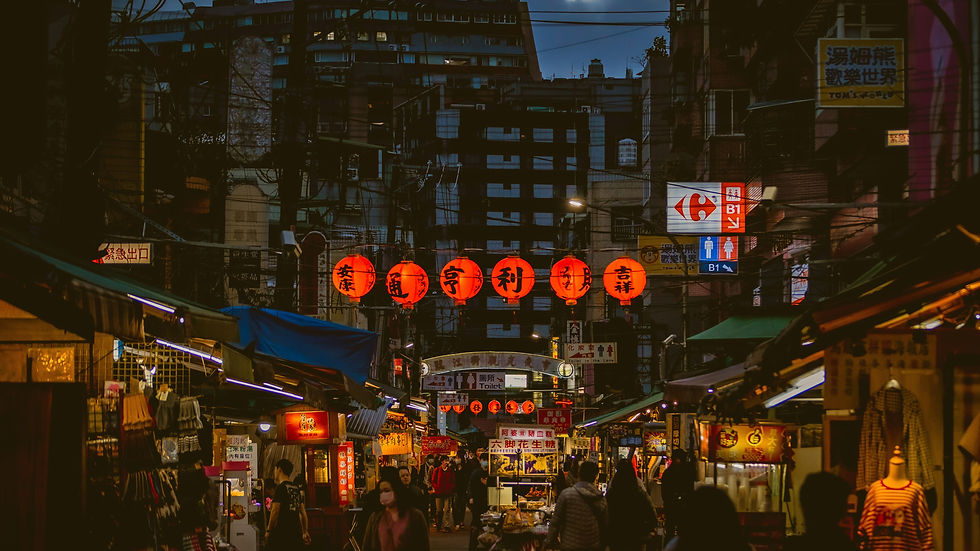
Of course, a trip to Taipei City would not be complete without feasting upon its bounty of delicacies. Perfect for an introductory meal to Taiwan on a Friday night. I-Hsuan says a visit to one of Taipei’s many night markets is a must. Famous spots include Raohe, Ningxia and Tonghua markets, but her personal favourite is Shilin Night Market, situated a few metro stops away from Taipei 101. “The night market is really noisy…lots of delicious food and then you can buy stuff, eat food, and you can also play some games.”
Alongside more street-food stalls than can be counted, Shilin also offers fairground-style games and attractions. My guide shares with me her favourite street snacks to sample, beginning with Taipei’s fried chicken and “special bubble tea,” which can be customised with different flavours and “bubbles”. Especially iconic is “stinky tofu”, a fermented soybean curd which is very popular amongst locals. The list doesn’t stop there.
“Pork blood cake, it’s also yummy, and the Taiwanese will put peanut powder on the pork blood cake and will also put cilantro on it” I-Hsuan says. She also recommends oyster omelettes, Taiwanese sausage wrapped in sticky rice and beef noodles. Truly, a visitor here is spoilt for choice. What’s more, street-food prices start at around £1, so these cravings are kind to your wallet. Shilin Night Market is open from 4 pm to 12 am every night.
Saturday is ideal for soaking up the city’s sights and sensations. If you are seeking culture and history, the National Theatre and Concert Hall is for you, a cultural centre and event space showcasing both Taiwanese and foreign talent. The exterior façade alone, a sublime example of Taiwanese architecture, makes the visit worth it. Guided tours start at a mere £3.80 for adults and £2.50 for students, and tickets to events vary greatly in price depending on the nature of the show. Both can be purchased from the National Theatre and Concert Hall site: https://npac-ntch.org/en. The centre is open daily from 12 to 8 pm.
I-Hsuan also recommends a visit to the Xia Hai Temple, located a 40-minute commute from downtown Taipei. Admission is free, and the temple is open from 7 am to 7 pm every day. Xia Hai famously houses the statue of “The Old Man on the Moon,” a kind of matchmaking deity in Chinese mythology. This attracts scores of hopeful singletons every year, who believe a prayer to the God may improve their chances of finding romance. I-Hsuan explains:
“They want to find a partner. They want to find love. So, they will go to this temple, and they say this temple is really good at finding love.” One to bear in mind if you’re feeling romantic, or if you simply want to dip your toes into the spiritual traditions of Taiwan.
Saturday dinner plans? It would be completely understandable for you to return to one of the city’s night markets to discover more weird and wonderful treats, but if restaurants are on your radar, head to Taipei’s infamous Ding Tai Fung. What began as a small family-owned business here in Taipei has grown into a worldwide phenomenon, serving up their infamous Xiaolongbao to hungry customers from Seoul to London. There are several branches across the city, including a Taipei 101 branch which is open daily from 11 am to 8.30 pm. A portion of 10 Kurobuta Pork Xiaolongbao will set you back about £14, and you can book and check waiting times on the Ding Tai Fung website: https://www.dintaifung.com.tw/eng/. A Ding Tai Fung waiting list app is also available on Apple and Android.
If by the time Sunday arrives you are craving an escape to the great outdoors, Yangmingshan National Park is an easily accessible option, with regular buses and shuttles (fares starting at 75 p) connecting the heart of the city to this mountainside haven. In less than two hours, you can come and refresh your senses by tranquil lakes, verdant slopes, and idyllic waterfalls. The park is free to enter. More information is available to tourists at https://www.ymsnp.gov.tw/main_en/.
Where should I stay?
I-Hsuan recommends a central stay, at the heart of the city’s action. Formosa 101 is an affordable hotel in downtown Taipei, only a ten-minute walk from Taipei 101. Room rates begin at a modest £35 for the night, providing decent hospitality in a strategic location for sightseeing. Bookings can be made on booking.com.
This brief guide only scratches the surface of what this city has to offer, but we hope these recommendations can help make your short stay an unforgettable one. Many thanks to I-Hsuan for taking the time to share her local insider tips.
More information on visiting Taipei City is available on Taiwan’s official tourism site: https://eng.taiwan.net.tw/w1.aspx.
Q & A
Q & A with Sheikh Abd al-Salam Manasra: Sufi Mystic, International Peacemaker and Israeli Director of The Abrahamic Reunion.
This peacemaker has known conflict and loss, but leads the organisation’s work for reconciliation and coexistence.
The Abrahamic Reunion is an interfaith organisation dedicated to, “uplifting human consciousness and building peace in the Holy Land and around the world” and promoting, “love, peace, communication, cooperation and dialogue among the people of the Holy Land.”
I spoke with The Abrahamic Reunion’s Israeli director, Sheikh Abd al-Salam Manasra, about the organisation’s origins and efforts for peace in an increasingly hostile region.
Q: Could you tell me how the Abrahamic Reunion began?
A: My grandfather Sheikh Abdusalaam Manasra started down this path, with a Jewish Rabbi, Rabbi Froman, about 45 years ago. It started with just a few people, and it is now thousands, who believe in peace in Israel and Palestine.
The Abrahamic Reunion formed in 2005, when my father and David Less and a few others like Eliyahu Mclean and Ibrahim Abu El-Hawa, prominent Jewish and Muslim peacemakers active in the Holy Land, got together in Turkey and established the Abrahamic Reunion.
Q: Could you tell me about the history of your family, and its connection to peace-making?
A: I am a member of the Sufi order, a branch of mysticism in Islam. Both my grandfathers were the heads of the Sufi order in the Holy Land, and today my father holds this title. We are from the North of Israel. Since the time of the Nakba (the mass displacement and dispossession of Palestinians during the 1948 Arab-Israeli war) we have been living near Nazareth. We lost land, we lost homes, we lost everything (during the Nakba).
But I am now the third generation working for peace, because we believe in peace. What happened, happened, but now we have to create this relationship. I grew up in a home where most of our friends were Jewish and Christians, and I grew up being treated as their own child. I have this connection with the people, and I believe in that.
Q: How does peace play out practically in your work? What kind of events does Abrahamic Reunion run?
A: We are creating four to five events monthly in Israel and Palestine. With the youth we are dealing with more sensitive things. For example, we visit Yad Vashem, the Holocaust Museum, and then we visit Ein Karem, an occupied village near Jerusalem, so we are talking about more political stories and what the solutions are and how we can face these challenges together.
We have a women’s programme, because we believe that women are the most important part of society, they can raise the society.
Also, there are programmes for families. We are trying to bring together families from all the religions in Israel: Druze, Jewish, Christian, Ahmadis, Baha’is and Samaritans from the West Bank, and Palestinian Muslims and so on. And all these families can be together, and this is the most beautiful picture you can ever see, because you see the children playing together. And you can touch the beauty at this time, the difficult time, when they continue this connection, they continue to talk to each other, to care about the safety of each other.
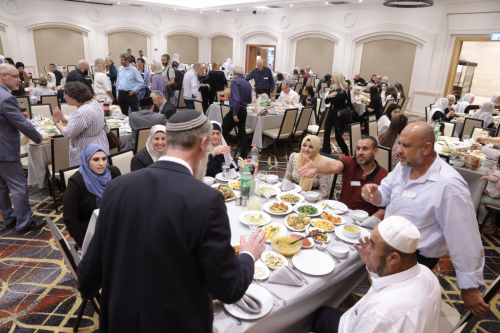
The Iftar in Ramadan, this is one of the other events we do, it brings together over 300 people every time, and we also do Christmas celebrations in Bethlehem.
In universities, we also run conferences and programmes with intellectual and clergy people. And we are trying to work with all the politicians, from right to left we have connections, because we believe in gathering and peace. The point is to go and to talk with the extreme people more, to try and change their minds.
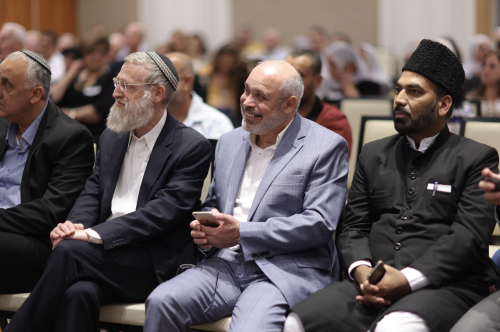
Q: How are Abrahamic Reunion responding to the current conflict in Israel and Gaza?
A: At this time, we are focusing on gathering, and praying only. We try and not discuss the very sensitive things; we have these kinds of programmes to deal with more sensitive issues, but it is more for the youth. For now, we are focusing more on gathering, because actually most of the people, they want peace, they want to live together, they want to stop the war.
EXHIBITION REVIEW
Exhibition Review: Our Connection to Water
A collection of international works in Greenwich explores the commodity we all depend on.
You’ve probably been told that the human body is composed of about 60 percent water. As such aqueous creatures, I think we can all find some connection to the National Maritime Museum’s multimedia exhibition which opened in March, Our Connection to Water. This humble exhibition’s draw is its universality, its relevance to every living being.
Curated by multidisciplinary artist Joseph Ijoyemi and artist-curator Lison Sabrina Musset and co-produced by The Collective Makers and Royal Museums Greenwich, Our Connection to Water brings together seven artists and storytellers from around the world: Aya Mohamed, Artemis Evlogimenou, Dafe Oboro, Giya Makondo-Wills, JIUN Collective, Paul Malone and Seba Calfuqueo. They explore the human connection to water, whether it be as a “life source”, “sacred ritual” or “scarce commodity”, through mediums of photography, audio and video, illustration, and installations. The works offer a fresh perspective on water, as something which is shared and precious, rather than simply something to master or a means to an end such as trade or conquest, as it is considered in the context of a maritime museum.
Upon entering the modest gallery space, visitors are exposed to Seba Calfuqueo’s TRAT TRAY KO, a video performance in which the artist carries an electric blue cloak into a “trayenko” or waterfall, exploring the indigenous Mapuche relationship with water and more broadly the forces of nature. It is mesmerizingly simple, visually bold and a fitting introduction to the rest of the exhibition.
Also standing out is 18-year-old Aya Mohammed’s series of six illustrations titled The River of Life, which discusses the importance of water in Sudanese culture, each image representing an aspect of water, as written in verses of the Quran. Through these simple yet sensitive depictions, London-based Mohammed offers us a youthful outlook on ancient traditions and a people whose daily lives revolve around the cycle of water, especially relevant with Sudan’s increasing struggles with flash-flooding and desertification.
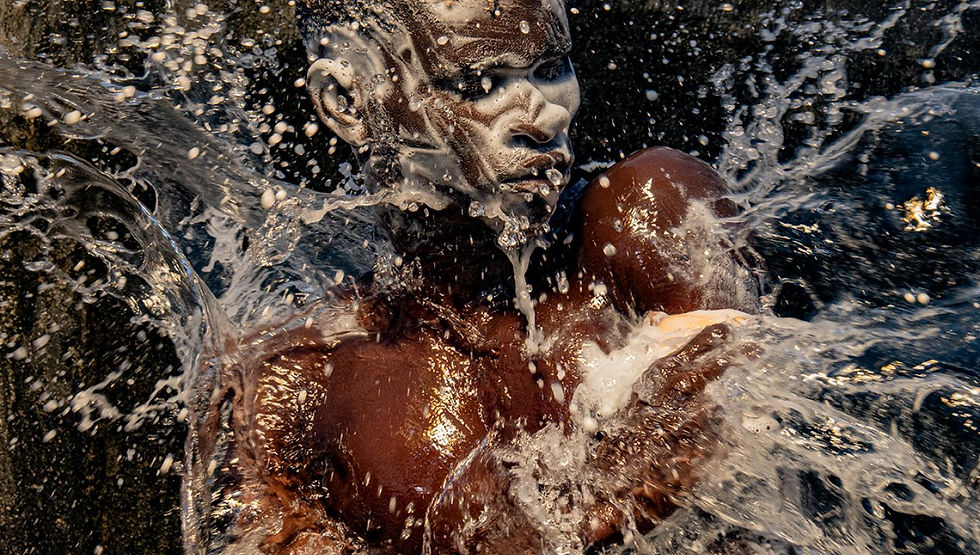
Equally visually impressive is Dafe Oboro’s Pour Me Water, Pure Water, a photography series centred on the idea of bathing as an essential everyday ritual, especially in the scope of Lagos’ local workers, “mechanics to plumbers to bricklayers”, who wash in the street. His subjects are compassionately portrayed, often mid-bathe, performing a simple human ritual but basic right which is not always accessible. Oboro’s work tells a story, one of colour and dignity despite poverty, which succeeds in challenging “reductive understandings of African countries” and creating a more nuanced portrayal.
I will frankly state that I failed to see the relevance of several of the works exhibited. JIUN Collective’s touching films exploring family connections over generations in Conversations with our Grandmothers is a heartwarming work, perhaps the most compelling of the exhibition. Artists and sisters Kharis, Verity and Stephanie speak with their Chinese-Malaysian and Pakeha (White New Zealander) grandmothers. Although there are brief, superficial mentions to ships, hinting at oceanic migration, there is little to root this work in the specific theme of water. Beautiful as it is, it would be more at home in a show exploring family connections or multiculturalism. Similarly, Artemis Evlogimenou’s West of the Sun, East of the Moon revolves more around the animal kingdom than it does around water.
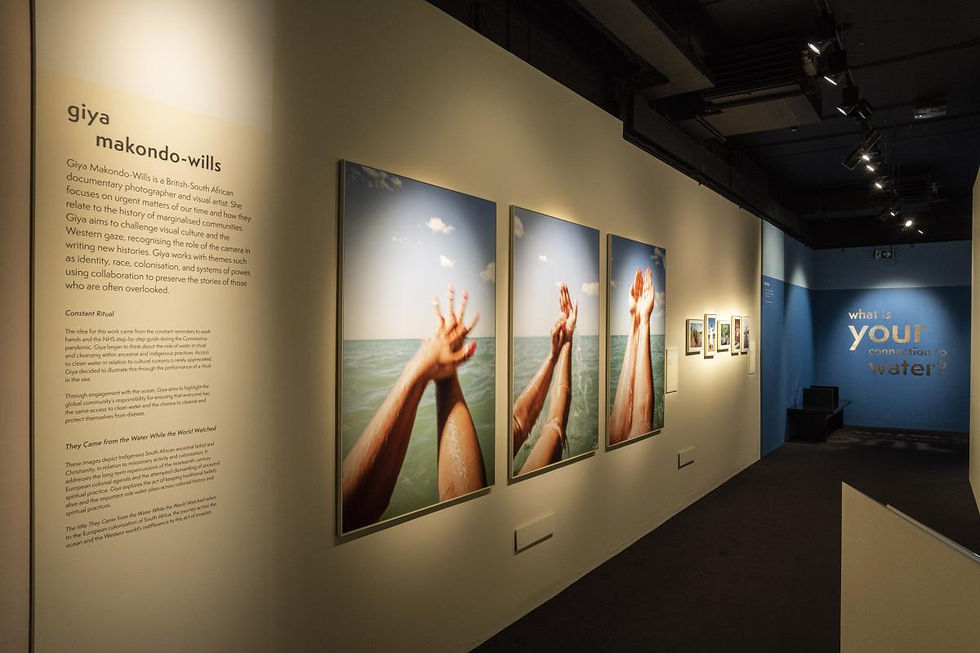
Despite the differing levels of relevance within the exhibition, any wrinkles are ironed out by the overarching theme of humanity and connectivity. Our Connection to Water offers a platform for Indigenous and other often overlooked voices, which remind us of our primordial need for the natural resource, and our responsibility as a species to preserve our water for future generations. Whether you want to dip your toe into the show’s visual aesthetics, or dive deep into the philosophy of water, this small but wise exhibition will have something to suit your taste.
Located in the National Maritime Museum in Greenwich, Our Connection to Water is free to enter and open daily from 10 am to 5 pm. See the museum’s website for details:


Comments